
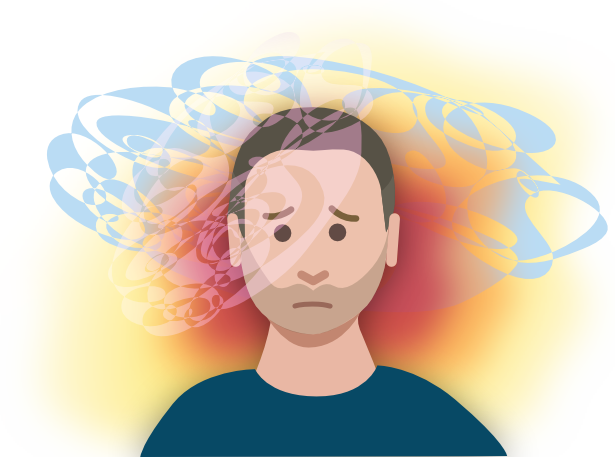
Worrying about falling, before you've gotten up to walk
Do you often find yourself worrying about things before they happen? Maybe you've delayed important decisions, avoided social events, or put off trying new things because you're concerned about what might go wrong. If this sounds familiar, you might be experiencing anticipatory anxiety — a common form of anxiety focused on worry about the future.
Anticipatory anxiety involves:
- Predicting the disappointment, frustration, or hopelessness you will feel if you fail to do something you have set out to do.
- Dreading the label 'failure' that you will give yourself if you believe you have 'let yourself down'.
- Fearing shame as a result of failure — that painful feeling of being judged or humiliated.
Anticipatory anxiety makes you imagine the worst outcomes. You might think:
- "If I try this new thing, I might not be good at it and feel like a failure."
- "If I don't get this right and make a mess of it, people will mock me."
- "If I don't do well, I'll let everyone down… I'll let myself down."
These thoughts can make you feel scared, sad, or angry before anything even happens. This anxious thinking can also involve imagining that you will fail 'again' — confirming the story you have already told yourself that you are somehow not good enough.
Anxiety and fear
Fear is how you react to danger right now
This could be how you react to an immediate threat, like a barking dog that might bite you or an aggressive person that might injure you. Your body will be ready for action: the fight, flight, or freeze response will be triggered.
You might freeze, hoping the threat will pass; become aggressive and defend yourself; or run away from the danger toward somewhere safe.
Once you think the threat has passed, the feeling of fear and the tension in your body will fade as you gradually become calmer and recover a more balanced state.
Anxiety is worrying about possible dangers in the future
Anxiety is something that most of us experience quite often during our lives. Our brains try to protect us by looking out for danger, which can be helpful sometimes, as we've just seen.
Anticipatory anxiety can help you prepare for challenges, think carefully before making decisions, and sharpen your concentration to perform a task better. The flip side of this natural preparation is when anxiety takes the form of worry about the future consequences of actions you intend to take.
You want to avoid uncomfortable feelings like self-doubt, disappointment, shame, and failure. You want to feel in control of your life. This uncertainty — this chance of things going wrong and the hurt you think might follow — really worries you.
How anticipatory anxiety affects you
Jake's story — how anticipatory anxiety shows up
Jake struggles with anticipatory anxiety. It shows up across many aspects of his life, but particularly in a few specific ways:
- Negative predictions, causing indecision that prevents him from achieving goals he has set for himself
- Perfectionism, driven by his dread of failure and shame — leaving him feeling that nothing he does is ever quite good enough
- Social anxiety, showing up in his anticipation of being judged negatively by others, not fitting in, or being rejected.
For Jake, this means he often gets excited thinking about a project he'd like to do and imagines how amazing it would feel to complete it. Once he begins to try to put together a plan of how he might begin to work on this project, his anxious predictions begin to kick in.
He becomes daunted by how much there is to do. He imagines a huge mountain of work, and completing it begins to seem less possible — or impossible. He tells himself to just make a start on one aspect, but then wonders if a different part of the project might be a better place to begin — and indecision kicks in.
On other occasions, Jake's perfectionist tendencies sabotage his work. He can't trust that his work is good enough — he's always doing just a bit more, or checking things one more time. This either leads to missed deadlines, or to Jake immediately assuming his work could have been better when someone reacts indifferently to it.
It's not just with goals and projects that Jake struggles, though. The social aspect of his anticipatory anxiety prevents him from making new connections with people. A colleague invites Jake to join her, as she is meeting a group in town, and suggests that he come along. Jake hesitates, says yes, then later wishes he hadn't.
He wants to meet new people, but he imagines the 'risks' involved:
- How many people is 'a group'?
- What kind of place are they going to?
- What if they all know each other and I feel awkward and left out?
- What if they think I'm boring, or I talk too much?
Jake does go in the end, and enjoys himself. But he'd considered cancelling, and it's clear how his anxious predictions hijack his imagination and make a simple social encounter very difficult.
Anticipatory anxiety that prevents you living your life fully
Your powerful imagination can create thoughts and fantasies of enjoying some fulfilling experience, or achieving success and receiving praise. You feel a tingling excitement that drives you to take positive action in that direction.
On the other hand, if your imagination and anticipatory anxiety combine, what you create is a picture of all the potential pitfalls of taking action. You might conclude, in an effort to regain a feeling of safety, that it's probably not such a good idea.
Both of these are fictions, created in your mind. When you find that more and more of your thoughts are full of anticipation of embarrassment, failure, and disaster, you might withdraw from the very thing you fear might lead to these outcomes.
This withdrawing could lead you to give up when anticipatory anxiety replaces excitement with doubt and fear of the emotions you imagine feeling. The more you pay attention to the negative predictions, the more they drown out the positive pictures that might drive you to take action.
Missing out
When you want to move towards something but begin to anticipate the risks involved, uncertainty leads to indecisiveness. You seek to reassure yourself by taking more time, looking for more information. You hope to avoid failure and the feelings of guilt and shame.
You get stuck in a loop of uncertainty — wanting to try something new, but finding that anxious predictions keep you in a middle ground. Here you hope to keep your fears at a distance by not taking action, but in doing so prevent the delight you might have experienced if you had gone ahead.
"Far better it is to dare mighty things, to win glorious triumphs, even though checkered by failure, than to take rank with those poor spirits who neither enjoy much nor suffer much, because they live in the grey twilight that knows not victory nor defeat."
— Theodore Roosevelt, The Strenuous Life (1899)
Breaking the cycle by moving from avoidance to acceptance
Avoiding the uncomfortable
Trying to avoid uncomfortable feelings and shrinking from the dread of failure is understandable. But acknowledging that your avoidance traps you in indecision and holds you back from experiencing life fully is an important first step in being able to manage it.
Focusing on process instead of outcome
When you focus on the outcome of something, it can often have a 'succeed' or 'fail' sense to it that can give rise to your anticipatory anxiety. The 'fail' part of the equation gets magnified, as your amygdala, the alarm centre of your brain, is triggered. In a heightened state, you look to escape the stress and anxiety, perhaps by putting off what you'd hoped to do, or abandoning it altogether.
When you focus instead on the process, and the steps involved in getting to your goal, you remove the all-or-nothing sense of it. If uncertainty arises, stop. Recognise the anxious predictions of failure that are brewing. Say to yourself: 'OK, this is a lot harder than I thought.' Then ask yourself:
- Is there another way to do this?
- Do I need some help, so I can continue?
- Is there something I can try right now, to make a start?
In asking these open, curious questions, you are accepting difficulty and giving yourself options. You are reacting more optimistically — halting the swell of anxiety about failure and seeking a way to continue with what you set out to do.
Accepting imperfection and uncertainty
Once you begin to allow yourself room for imperfection — once you realise that while there can always be 'better', 'good enough' is a perfectly good place to begin — it becomes easier to take a first step.
Once you accept that it is OK to feel uncertain, but decide to go ahead anyway, holding on to the possibility of positive outcomes, you break free of that contained place of false safety that prevents you from fully living your life.
Practice makes perfect? No, but it makes more than good enough
When you begin to accept uncertainty and do something anyway, you start to see that while parts of the experience may be uncomfortable, you come out of it OK. You lessen the power of anticipatory anxiety and reclaim your imaginative abilities — to picture more enjoyment and success, and less fear and failure.
DANCE
In the book Overcoming Anticipatory Anxiety, Sally M. Winston, PsyD, and Martin N. Seif, PhD, outline five steps for managing anticipatory anxiety, captured in the acronym DANCE:
- D — Discern (or recognise) your anticipatory anxiety as imagination, memory, sensitivity, or mood, and disentangle yourself from the anxious thought.
- A — Accept doubts and discomfort willingly.
- N — No struggling, avoiding, reassuring, or overthinking.
- C — Commit to proceed with action or choice.
- E — Embrace the present as it is and let time pass.
Key takeaways
Understanding anticipatory anxiety
- Anticipatory anxiety is a common experience where you worry about future events and imagine negative outcomes.
- While some future-focused anxiety is natural and can be helpful, excessive worry can prevent you from living life fully.
- Your imagination can work both for and against you — creating either positive visions that motivate you or negative predictions that hold you back.
Recognising the pattern
Anticipatory anxiety often shows up as:
- Avoiding new experiences or social situations
- Putting off decisions due to fear of making mistakes
- Excessive "what if" thinking about negative outcomes
- Physical feelings of stress or tension when thinking about future events
Practical steps
- Start small — take one step at a time toward your goal.
- Accept that uncertainty is part of life's journey.
- Balance negative predictions with possible positive outcomes.
- Focus on the process and the growth that is part of applying yourself to it, rather than demanding perfect results.
- Use difficulty as information to adjust your approach, not as a signal to stop.
Moving forward
By accepting that you can experience difficulty, failure, and embarrassment and still be OK — even when it's difficult in the moment — you free yourself to consider the good experiences that are possible too. Your anticipation can move from fearful worry to being excited about new things and looking forward to what's ahead. Remember the DANCE approach.